
Most P&C teams are operating inside workflows that were never designed for today’s specialty market. Submission volumes are rising, data lives everywhere, and underwriters are spending more time managing process than evaluating risk.
That was the opening statement of our recent webinar, and it set the tone for an hour-long conversation about what’s actually breaking down in underwriting operations and what’s replacing it.
We brought together Mladen Subasic (Chief Product Officer at BoundAI and OIP Insurtech), Shawnae Bentley (VP of Strategic Partnerships at OIP Insurtech), and AJ Beatovic (Head of Go-to-Market at OIP Insurtech) to discuss AI adoption, operational bottlenecks, and what MGAs and carriers can do today to modernize their workflows.
If you missed it, here’s what we covered.
Where the Traditional P&C Model Breaks Down
We kicked off with a poll: Where is your organization on its AI journey?
The results were split. About half the audience was in the exploratory phase, while the other half was already piloting and experimenting with AI. Only a small portion was running multiple live projects simultaneously.
That tells us most organizations are still figuring out what AI can actually do for them and where it fits into their operations.
So, where does the traditional P&C underwriting model start to break down as you scale?
Mladen was quick to clarify: the underwriting itself isn’t broken. Underwriting judgment and risk evaluation are more important than ever, especially in specialty lines. What’s breaking is the infrastructure around it.
“The structural problem is how technology has been installed over the years,” Mladen explained. “If everybody wants to move faster, there’s a big roadblock in the way these systems are supporting that mandate.”
The issue isn’t underwriters. It’s the tech stack they’re forced to work with.
Shawnae, who spent years as a frontline underwriter, added another layer: scale stresses workflows, not judgment.
“Before I could actually quote submissions, I was triaging emails, extracting attachments, reconciling loss runs, cleaning up SOVs, or chasing missing information,” she said. “When you’re buried in that operational drag, the turnaround time expectations don’t slow down. That’s when underwriting discipline can start to erode, not because underwriters lack skill, but because the systems around them create time pressure and overload.”
The Data Problem Is Not About Quantity
Insurers and MGAs aren’t short on data. They’re short on usable insights extracted from that data.
The question is, can you access your data when you need it, trust it when you see it, and use it to make better decisions?
Mladen pointed out that data has always existed in insurance. Carriers have been collecting and storing it for decades. The difference now is timing.
“The mandate for carriers is shifting to the left,” he said. “Decisions need to be made faster, and risk needs to be quoted faster. That means pushing access to data to the gate.”
For MGAs and brokers, the situation is different. Historically, they only stored enough data to issue an invoice. The rest lived in emails, PDFs, and spreadsheets, untouched except by human eyes.
AJ emphasized that the biggest roadblock isn’t the lack of data. It’s where the data lives.
“A lot of our partners have data in their system, but the system doesn’t have a great reporting layer. And even if it’s in the system, the data isn’t highly accurate,” he explained. “The real data typically lives in PDFs, emails, and attachments. You need to find a way to extract that data so you can make insights off of it.”
The solution? Modern extraction, transformation, and loading (ETL) processes that can pull data from unstructured sources and structure it in real time, without manual rekeying.
Where Underwriters Lose the Most Time
We ran another poll: What does your underwriting team lose the most time on?
The winner, by a landslide: chasing missing information.
It wasn’t even close. Reconciling loss runs and SOVs came in second, but chasing missing information dominated the results.
Shawnae wasn’t surprised.
“Part of that is just the process of underwriting,” she said. “Every underwriter is going to have their own angle on that risk and want certain information. But if we can get the bulk of it clean and early, that changes everything.”
The problem is that underwriters often submit minimal information upfront because they’re only quoting and not binding. Why spend time entering data if there’s only a 20% chance of winning the business?
But that creates a vicious cycle. Incomplete submissions lead to back-and-forth requests, which slow down quotes, which hurt bind ratios, which reinforce the behavior of submitting incomplete information.
“What’s the opportunity cost of not capturing that data early?” Shawnae asked. “What story are you missing because you’re left in the dark? Getting clean, good intel early on allows underwriters to take a more strategic approach, knowing what they’re not writing that they should be writing, or who’s feeding them business with a high bind ratio so they can prioritize it.”
When underwriters don’t have time to think, they can’t manage their portfolios strategically. And in a soft market, thinking is what protects your combined ratio.
Roadblocks to Better Workflows
We ran a third poll: What percentage of your underwriting time is spent on non-revenue generating or administrative tasks?
The majority of respondents said 25-50% of their time. Some even reported 50-75%.
That’s a staggering amount of time spent on work that doesn’t directly contribute to writing business or evaluating risk.
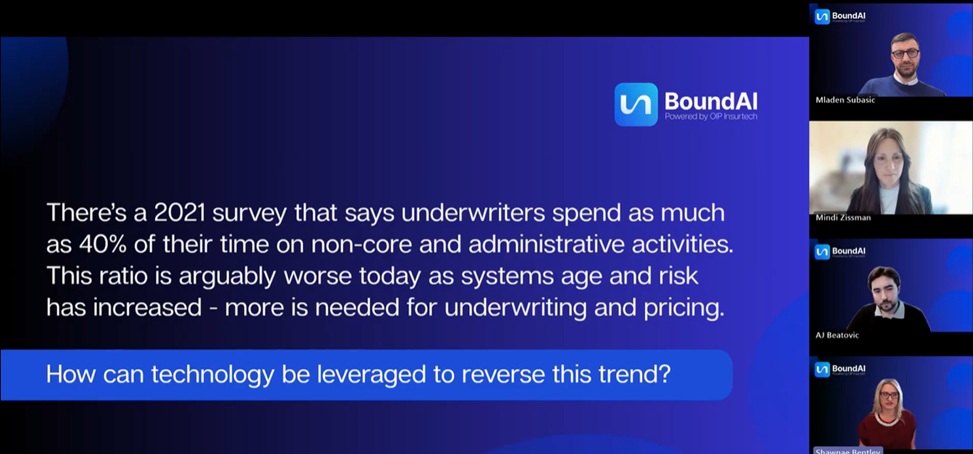
And here’s the kicker: that number hasn’t changed much in the last few years. A 2021 survey found that about 40% of underwriters’ time was spent on non-core, administrative activity. The results from our poll showed we’re still in that same range, despite all the AI innovation happening in the market.
So what’s the roadblock?
AJ pointed to the systems themselves.
“The biggest roadblock is the system where everything’s living,” he said. “A lot of our partners have data in their system, but the system doesn’t have a great reporting layer. And even if the data is in the system, it’s not highly accurate. The real data lives in PDFs, emails, and attachments.”
The solution isn’t just better reporting. It’s extracting data from unstructured sources and loading it into a structure that underwriters can actually use without manual rekeying.
Mladen added that it’s time to make harder decisions about legacy technology.
“Traditionally, everybody’s been relying on their core system and spreadsheets,” he said. “Spreadsheets have almost been a core system for underwriters more than their own policy administration systems. But now it’s time to decide: if the core system isn’t supporting your next step, you may need to abandon it.”
That’s a tough decision. But the good news is that new solutions exist today that can move data from traditional cores to modern layers without forcing a full rip-and-replace.
How to Win Back Underwriting Time
So how can technology actually reverse this trend and give underwriters their time back?
AJ introduced what he called the “bow tie” model.
On the left side of the bow tie, you have cost, efficiency, and control. These are the operational improvements that reduce manual work, lower expenses, and create structure. Once those are in place, you unlock the right side of the bow tie: capacity and revenue expansion.
“It all starts with the efficiencies,” AJ explained. “Fewer manual processing steps, less dependency on scaling support staff, and lower expense ratio pressure. That’s automating administrative processes, gaining efficiencies for underwriters, and operating off one single panel of glass rather than 20 different touch points.”
Even a 30% efficiency gain can have a massive impact. Underwriters get more time. They can issue more quotes. They can analyze risk instead of chasing documents.
And in a soft market, that matters even more.
Shawnae emphasized that the real issue is what time pressure does to decision-making.
“You can’t hire your way out of inefficiency,” she said. “Your expense ratio is where the pressure point is now. If almost half of your underwriting time is spent cleaning up submissions, structuring emails, and reconciling data, that margin compression is happening in real time.”
Technology doesn’t become leveraged until it gives you your time back. AI is clearing the operational drag so underwriters can think.
“In a soft market, thinking is what protects your combined ratio,” Shawnae said. “You have to have time to think.”
Choosing the Right Tech Partner
With so many AI solutions flooding the market, how do you choose the right tech partner?
Mladen’s advice: take time to plan.
“Before deciding on any technology journey, take time to plan, and as much time as you think you need, times two,” he said. “Figure out what the exact problem you want to solve.”
Not every organization needs the same solution. If you have a strong technology team in-house, you might just need an infrastructural layer or an API. But if your organization has been struggling to identify the right use cases, choose partners with broader capabilities – consulting, professional services, and a deep understanding of insurance workflows.
“Choose people who are playing in the domain, who understand the way you work and think, rather than just sticking another tool to the toolkit and hoping it works because it does great in demos,” Mladen said.
The gap between a great demo and actual production is real. Many projects look impressive in a presentation but fail when it’s time to integrate with existing systems, avoid data duplication, or get buy-in from underwriting teams.
AJ doubled down on the integration piece.
“A lot of companies can do data extraction, but they’re not implementing it to the business case,” he said. “They’re not looking through the SOPs, understanding the decision maps, the decision trees, and how everything actually works. As a result, a lot of these projects fail at scale.”
The key question to ask any partner: Who owns the integration and implementation?
If the answer is vague, that’s a red flag. You don’t want to buy a solution and then realize you need a separate team to actually make it work.
Shawnae added that bringing the business in early is critical.
“A lot of times we see companies not bringing the business in early enough,” she said. “You have to understand your own workflow first. If you don’t know where your time is leaking, you’re positioning yourself to buy features instead of outcomes.”
Technology should transform the workflow instead of just sit on top of it.
What to Do Right Now
So what can MGAs and carriers do today (right now, in Q1 2026) to actually move forward?
Shawnae’s advice: don’t start by buying software. Start by shifting the mindset.
“Stop treating technology as a side project and start looking at your workflow design as a strategy,” she said. “Ask yourself: what part of this process truly requires human judgment? Everything else is a candidate for automation.”
You don’t have to overhaul everything at once. Start with one bottleneck, one workflow, one line of business. Fix that, prove it works, and scale from there.
Mladen echoed that approach.
“There are so many good ideas inside every organization,” he said. “Stack rank those ideas. Look at the market, get educated, and then match what’s available with where your friction actually is.”
He also emphasized the importance of making hard decisions about legacy systems. The most successful organizations are the ones willing to make the cuts and move away from systems that no longer support their growth.
AJ’s recommendation was even simpler: start with education and adoption.
“The majority of people on this webinar are using Microsoft. They have access to Copilot,” he said. “Teach your underwriters how to use those more readily available AI systems first. Then, when you start adopting newer, more insurance-specific technologies, your teams are excited, they can’t wait for them, as opposed to trying to poke holes in every new technology that comes their way.”
Education builds buy-in. And buy-in is what makes implementation successful.
For organizations ready to take the next step, platforms like BoundAI are already solving these problems at scale. Built specifically for insurance workflows (submission intake, risk triage, document validation, decision support) BoundAI eliminates operational drag without replacing underwriting judgment. It’s not a side tool. It’s infrastructure.
Conclusion
The traditional P&C playbook isn’t broken because underwriters can’t evaluate risk. It’s broken because the systems around them create friction, slow down decisions, and bury judgment under administrative work.
AI isn’t here to replace underwriters. It’s here to give them their time back.
The organizations that will win in the next phase of the market aren’t the ones with the most advanced AI demos. They’re the ones that understand their workflows, choose the right partners, and focus on outcomes.
If you missed the live webinar, you can watch the full recording here. And if you’re ready to explore how BoundAI can help modernize your underwriting operations, reach out to us.
The playbook is changing. The question is: are you ready to change with it?