
Manual submission intake costs MGAs and wholesale brokers more than they realize - in time, errors, and business that never gets quoted.

Walk onto any conference floor where MGAs and wholesale brokers gather, and you will hear the same complaint over and over.
The submission process is too manual.
Ops managers say it. Underwriting support teams say it. Brokers say it too, usually right after they describe waiting days for a quote that should have taken hours.
The conversation always ends the same way. Someone says they are working on it. Then everyone moves on to the next session.
But every submission that comes in while nothing changes adds to a cost that most MGAs and wholesale brokers are not actually tracking. Insurance submission intake automation is not a nice idea for later. It is the difference between an operation that scales and one that quietly falls behind.
Forget the process diagram on the website. Here is what actually happens, step by step, on a normal day.
Submissions arrive by email, spread across multiple inboxes. Subject lines are inconsistent and attachment names rarely match what's actually inside them. Someone on the underwriting support team has to open each email by hand, figure out what documents are attached, and sort them before anything else can happen.
From there, documents get pre-processed. That might mean printing, scanning, or simply reading through each file to figure out what type of document it is. Once that's done, the relevant data fields get typed into the AMS or PAS, one at a time. Someone checks the entry for mistakes, though this step is often skipped when the queue is long.
The submission then sits and waits until an underwriter has time to look at it. If something is missing or wrong, the process loops back even further. The broker gets a call, the missing piece gets chased down, and the data gets re-entered.
From the moment a submission lands in the inbox to the moment it is actually quote-ready, the elapsed time runs anywhere from a few hours to several days. It depends on volume, staffing, and how many things go wrong along the way.
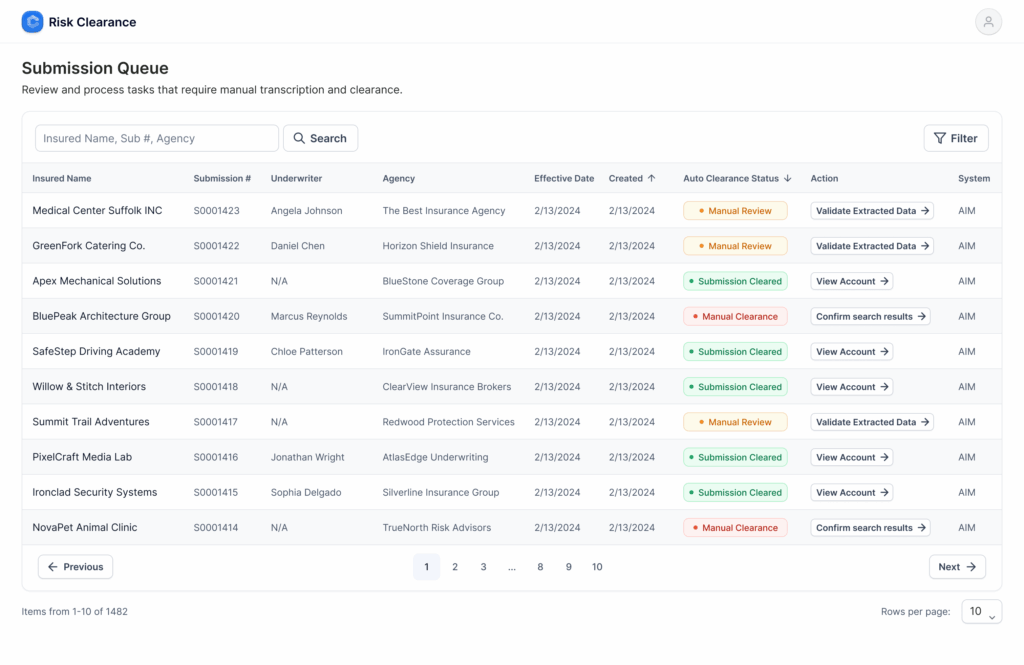
The hours add up faster than most people realize, and they add up in places that are easy to overlook.
Email triage and sorting takes 5 to 10 minutes per submission. Identifying and pre-processing documents adds another 10 to 15 minutes on top of that. Manually keying data into the AMS or PAS takes 15 to 30 minutes depending on how complex the submission is, and checking the entry for errors adds another 10 to 20 minutes if anyone has time to do it properly.
Add it all up and a single complex E&S submission can take 40 minutes to over an hour to process, and that's before an underwriter has even looked at it.
Now scale that across a normal week. An MGA processing 200 submissions per week is spending more than 130 hours on intake alone. That's the equivalent of three full-time employees doing nothing but moving data from one place to another, every single week.
None of that time involves underwriting judgment. It's pure administrative work, and it's happening at every MGA and wholesale broker still running this process by hand.
Manual data entry produces errors at a fairly predictable rate. Industry benchmarks put manual entry error rates at 1 to 4 percent per field, which sounds small until you look at what a typical E&S submission actually involves.
A submission with 50 or more relevant data fields will, on average, contain multiple errors by the time it's fully entered. And those errors carry real costs:
The real problem is how these errors travel. An error entered at intake doesn't stay contained. It moves downstream through rating, through binding, through issuance, getting harder and more expensive to catch and fix at every stage it passes through.
This is the cost that never shows up on a spreadsheet, and it might be the biggest one of all.
Global commercial insurance rates fell 5% in Q1 2026, marking the seventh consecutive quarterly decline, according to Marsh's Global Insurance Market Index. In a softer pricing environment like this, execution speed becomes an even bigger competitive factor than it already was.
In E&S placement, speed wins business. The first MGA or carrier to come back with a clean, accurate quote frequently gets the deal, regardless of how good the underwriting behind a slower quote might have been. When submission intake takes hours instead of minutes, response time suffers, and brokers move on to whoever responds first.
Peak periods make this worse. Submissions that arrive during renewal season, after a CAT event, or during any kind of market disruption sit even longer in a manual queue, because the volume spike hits an intake process that was already running at capacity.
Most carriers and MGAs end up quoting only a fraction of the submissions they actually receive. That's rarely an appetite decision. It's a capacity problem, plain and simple, and the business that never gets quoted is invisible on the P&L even though it's very real lost revenue.
When submission volume grows, the default response is almost always the same: hire more underwriting support staff.
That solution comes with its own set of costs that don't show up until later. Each new hire adds salary, benefits, training time, and management overhead. New hires also take weeks to become fully productive, and that ramp-up period happens while submission volume keeps piling up around them.
Peak periods add another layer of difficulty. Temporary capacity is expensive to stand up quickly and just as inefficient to wind down once the surge has passed. And when experienced staff eventually leave, they take the institutional knowledge of how submissions actually get processed with them.
The math behind manual intake is fundamentally linear. Double the volume, and you need to double the headcount. For an MGA competing in a market where submission volumes keep climbing, that's not a model that scales. It's a model that gets more expensive every year, without ever getting more efficient.
Some MGAs and carriers have already made the move to automated submission intake, and the gap between them and everyone else is becoming hard to ignore.
A national MGA using BoundAI now processes more than 2,000 submissions per day, responds to brokers five times faster than before, and has improved bind ratios without adding a single new hire to underwriting. That's not a future scenario. That's happening right now, in the same E&S market everyone else is competing in.
Brokers notice these differences too. They tend to route submissions toward whoever picks them up fastest and responds with the most reliable information. The MGAs still running submissions by hand are not just operating less efficiently. They are directly competing against operations that have already removed the human bottleneck from their intake process entirely.
Automating intake end-to-end changes more than just speed. It changes how the entire operation runs.
Here's what shifts when the process is fully automated:
The underwriting support team's role shifts too. Instead of spending the day on data entry, they move into exception review and other higher-value work that actually uses their judgment.
This is what insurance submission intake automation looks like in practice, not as a concept, but as a working system processing real submissions every day.
BoundAI's Document AI platform was built specifically to automate the full submission intake pipeline for E&S carriers, MGAs, and wholesale brokers.
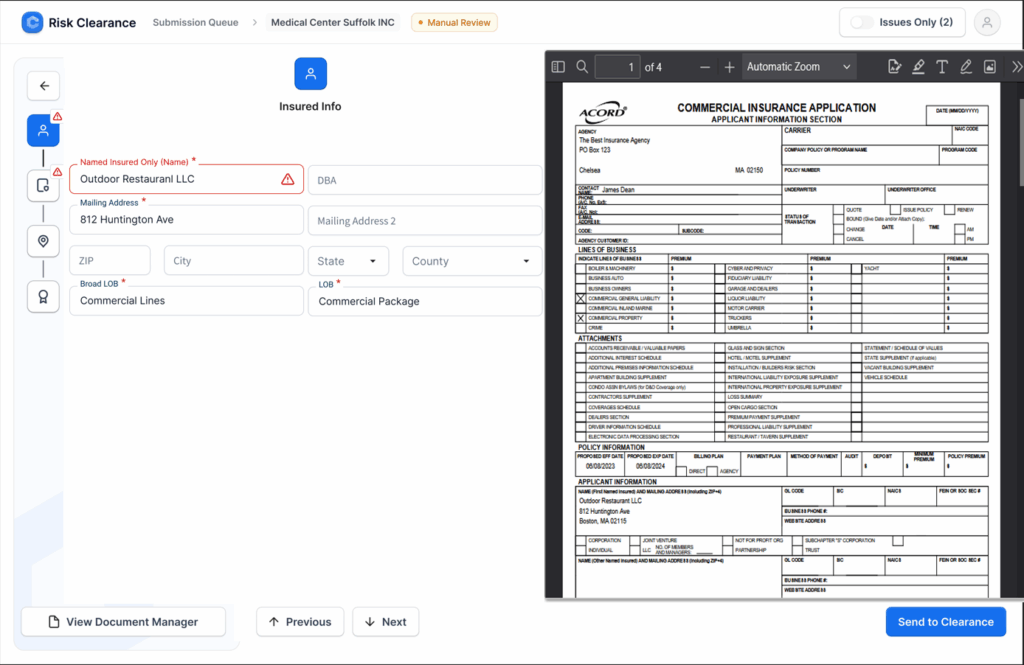
The platform handles the entire process without manual sorting or pre-mapping:
It integrates directly into existing AMS and PAS systems, so there's no rip-and-replace project and no parallel workflow to manage on top of everything else. An expert-in-the-loop design routes genuine edge cases to human reviewers inside the platform itself, while everything else clears automatically without anyone needing to step in.
Most deployments are up and running within 8 to 16 weeks.
Manual submission intake has a real cost. It shows up in the hours lost to administrative work, in the errors that travel downstream and get more expensive at every stage, in the business that never gets quoted, and in the competitive position an MGA or wholesale broker holds in a market that keeps moving faster.
The teams that have already automated this process are not just saving time. They are operating at a different speed and quality level entirely, and that gap grows wider with every submission season that passes.
For MGAs and wholesale brokers still running intake by hand, the real question isn't whether to automate. It's how much longer the current model can hold up before the cost of standing still becomes impossible to ignore.