
Agentic AI is everywhere in insurance, but rarely explained in the E&S context. Here's what it actually means for underwriting operations.
"Agentic AI" is one of the most overused phrases in insurance technology in 2026. It appears at conferences, in vendor decks, in trade press coverage of nearly every new platform launch.
The coverage rarely explains what it actually means for an underwriting operation. Technical explanations dive into model architecture and multi-agent frameworks. Generic explanations say it automates tasks and saves time. Neither helps an MGA ops manager decide whether the technology solves a real problem in their workflow.
Agentic AI represents a genuine capability shift for E&S underwriting operations. Understanding what it does differently from everything before it is the only way to separate the meaningful from the marketed and to know whether a platform claiming to be agentic actually is.
To learn more about how BoundAI can help you, please contact our team.
Insurance has been through several waves of technology that arrived with significant claims attached. Understanding where agentic AI sits in that progression matters because much of what is currently being sold as AI in insurance still runs on older foundations with newer branding.
The first wave was rules-based automation: explicit if-then logic that worked in controlled environments with predictable inputs. When documents didn't match the expected format, the system broke. No flexibility, no adaptation.
Machine learning and OCR moved the needle. These systems learned from examples rather than requiring hand-written rules, and accuracy improved. The limitation held: training on specific document types meant performance degraded on unfamiliar formats. Edge cases still required manual handling.
Large Language Models changed the underlying capability. LLMs understand context and infer meaning rather than matching patterns. A document the system has never seen before stops being an automatic failure.
That distinction matters for anyone evaluating technology in this space. Many platforms using the language of modern AI still run on rule-based or OCR-dependent architectures underneath. The marketing has outpaced the technology in a number of cases. Asking the right questions about how a system handles variation and edge cases is the only reliable way to tell the difference.
Agentic comes from agency - the capacity to take independent action toward a goal. An agentic AI system doesn't wait for step-by-step instructions. It receives a goal, determines the necessary actions, executes them in sequence, handles variations along the way, and delivers the completed output.
A traditional extraction tool does one thing: it reads a document and pulls a specified field. That's a computation. It has no ability to determine what kind of document it's looking at, whether the data makes sense, or where it should go next.
Consider what happens when a submission email arrives in a BoundAI inbox. Without separate instructions for each step, the system:

Every one of those steps involves a decision. What is this document? What fields matter? Does this value make sense? Where does this data belong? That sequence of autonomous decisions toward a defined goal is what makes a system agentic.
The practical analogy: a calculator requires you to specify every operation. An analyst receives a goal and determines how to reach it. Agentic AI operates at the analyst end of that spectrum, and that's what changes what's operationally possible.
Standard insurance lines have a predictable document landscape. ACORD forms follow consistent structures. Submissions arrive in formats that brokers and carriers have standardized over years of working together.
E&S and specialty lines are a different environment entirely. Broker-specific submission formats, manuscript endorsements, SOVs in hundreds of variations, loss runs across 400+ carrier formats, handwritten annotations, non-standard supplementals, all of it arrives in the same inbox and needs processing with the same accuracy and speed regardless of format.
Rules-based systems fail here because they require documents to match expected patterns. OCR tools fare somewhat better but still depend on training data covering specific formats. A loss run from a carrier the system hasn't seen before produces degraded results.
The document variety in E&S is too large and too dynamic for static approaches. BoundAI has processed loss runs across 400+ distinct carrier formats. Manually mapping every variation isn't operationally viable. The combinations across document types, formats, brokers, and carriers make it unworkable at scale.
Agentic AI reads each document, understands what it is, and determines what data matters from it based on context rather than position or format. The variation that breaks other tools is the environment agentic AI was built to handle. For MGAs and specialty carriers processing high volumes of non-standard submissions, that capability difference determines whether automation is viable across the full book or only on the cleanest portion of it.
Walking through a real E&S submission workflow makes the agentic capability concrete. Here's how BoundAI processes a submission from inbox to AMS entry without a human touching anything in between.
A submission email arrives. The system picks it up immediately and begins processing every attachment without waiting for manual sorting or pre-processing.
From there, the pipeline runs automatically:
The underwriter opens a file that is already classified, extracted, normalized, validated, and cleared.
A reasonable concern about autonomous decision-making across insurance workflows is what happens when the system gets something wrong. The answer is positioning it where it actually adds value.
The mechanism is confidence scoring combined with exception routing. When confidence is high and data validates cleanly, the workflow continues automatically. When confidence falls below threshold, the item gets flagged and routed to a human reviewer rather than pushed through.
In BoundAI's architecture, that review happens inside the platform. A specialist examines the flagged item, makes the determination, and corrected data continues downstream. The underwriter receives a complete, cleared file without the submission sitting in a manual queue.
This produces better accuracy than either full automation or full manual processing alone. Full automation without confidence gating passes errors through at whatever rate the system produces them. Full manual processing introduces human error at a predictable rate and caps throughput at headcount. The expert-in-the-loop model captures automation's speed on structured, high-volume work while applying human judgment where the system identifies genuine uncertainty.
For carriers and MGAs under delegated authority, there's a compliance dimension too. Regulatory frameworks in delegated authority environments often require documented review processes for certain decisions. A structured, auditable exception review process built into the platform addresses that directly.
The manual intake picture is familiar to anyone who has worked in an underwriting support team. Submissions arrive by email. Someone opens each one, sorts the attachments, pulls relevant data, and keys it into the AMS. Complex submissions take longer. Peak periods create backlogs. Errors surface downstream, sometimes after the quote has already gone out.
Throughput in that model is capped by headcount. More volume means more people, more training time, more inconsistency, and higher administrative cost.
With agentic AI in production, the picture changes significantly. Submissions arrive and the full pipeline runs automatically. By the time an underwriter looks at a file, it's already classified, extracted, normalized, validated, and written into the AMS. Turnaround drops from hours or days to under one minute. Processing capacity reaches 1,200 submissions per hour regardless of season.
The data quality improvement compounds across the operation:
The competitive consequence is direct. Faster intake means faster broker response. In E&S placement, the first clean quote frequently wins the business. One national MGA processing 2,000+ submissions per day through BoundAI responded to brokers five times faster and improved bind ratios without adding headcount.
For ops managers evaluating where leverage actually sits, intake is consistently where the largest gains are available.
The practical challenge for anyone evaluating AI platforms in insurance right now is that "agentic" has become a marketing term as much as a technical one. Most vendors operating in this space use the language. The underlying architecture varies significantly, and a demo environment with prepared documents doesn't always reveal where a system's actual capabilities end.
These questions will surface the difference faster than any feature comparison:
A system that answers all six with specifics and demonstrates them on documents the vendor hasn't seen before is operating at the agentic end of the spectrum.
BoundAI was built as an agentic, LLM-native platform from the ground up. That architectural difference produces fundamentally different results when handling the document complexity that defines E&S and specialty lines.
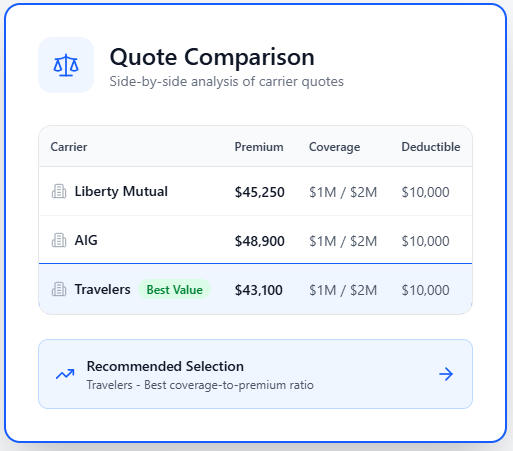
Document AI handles the full submission intake pipeline agentically. Every document type arriving in a submission inbox, regardless of format, broker, or carrier, gets classified, extracted, normalized, validated, and written into the AMS or PAS without pre-mapping or manual pre-processing. Loss runs across 400+ carrier formats, SOVs in hundreds of variations, ACORDs, supplementals, and broker-specific packages all move through the same pipeline.
Document Intelligence applies the same approach to policy validation. Quote, bind, and issued policy get compared at the clause level. Endorsement drift gets detected before issuance. Subjectivities are enforced. Compliance gaps surface before they reach the book.
The expert-in-the-loop design is built into the architecture, not configured as an add-on. Confidence scoring and exception routing run on every submission. Flagged items reach a human reviewer inside the platform with the context needed for a fast determination, and corrected data re-enters the pipeline without disrupting the rest of the workflow.
Deployment happens inside existing infrastructure via API for modern systems and RPA for legacy platforms. No existing AMS, PAS, or CRM needs replacing. Implementation completes in 8 to 16 weeks.
Agentic AI is a specific and meaningful capability, not a rebranding of tools that have existed for years. The distinction matters because the E&S and specialty lines market is exactly the environment where that capability gap shows up most clearly, and where the operational consequences of getting it wrong are highest.
The document complexity in specialty lines, the format variation, the non-standard submissions, the loss runs across hundreds of carrier formats, is the problem agentic AI was built to handle. Earlier approaches required the incoming document to conform to expected patterns. Agentic systems understand what a document is and what data matters from it regardless of how it arrives, which is the only approach that holds up reliably across the full range of what an E&S inbox actually contains.
For MGAs, carriers, and brokers still running manual or OCR-dependent submission workflows, the operational gap relative to teams that have deployed agentic infrastructure is growing with every submission season. The throughput difference, the turnaround difference, the data quality difference, all of it compounds over time into a competitive positioning gap that gets harder to close.
The questions worth asking when evaluating any platform claiming to be agentic are practical ones: how does it handle a document format it hasn't seen before, what happens when confidence is low, does it normalize data or just extract it, and what does the exception review process actually look like in production. The answers will quickly surface whether a system is genuinely agentic or whether the label is being applied to something that still requires significant manual handling around its edges.
To learn more about how BoundAI can help you, please contact our team.