Few phrases are used more loosely in insurance than end-to-end automation. Vendors promise it. Leaders ask for it. Decks are built around it. In theory, it suggests a future where submissions flow in, decisions flow out, and humans step aside.
In commercial insurance, that future doesn’t exist.
The idea of end-to-end automation comes from environments where work is standardized, data is structured, and decisions rarely require interpretation. Commercial and specialty insurance operate under very different conditions. Submissions arrive incomplete. Documentation varies by broker and program. Coverage is negotiated. Appetite shifts. Compliance depends on context rather than rules alone.
This is where the myth begins to break. Automation itself is not the problem. The problem is the assumption that complex, judgment-heavy workflows can run without human checkpoints. When teams try to force full automation into environments built on variability, the result isn’t efficiency. It’s hidden rework, governance gaps, and risk that surfaces too late.
To understand where automation truly works in commercial insurance, we first need to separate what can be automated from what shouldn’t. Only then does automation become an advantage instead of a liability.
Where the Idea of End-to-End Automation Comes From
The push for end-to-end automation didn’t start in commercial insurance. It started where automation genuinely worked.
Personal lines and simple SME products proved that straight-through workflows could deliver speed and cost savings. Submissions followed predictable formats. Rating inputs were standardized. Decisions relied on stable rules. In those environments, automation reduced friction without compromising control.
The mistake came when those successes were projected onto commercial and specialty insurance. Leaders assumed that what worked for transactional products would scale to judgment-heavy business. Vendors reinforced that belief, often reusing the same language while quietly narrowing the scope of what “end-to-end” actually meant.
Commercial insurance doesn’t behave like a transaction. It behaves like a negotiation. Risks vary widely. Coverage is adjusted. Documentation is layered. Authority depends on context and explanation. The conditions that make full automation viable simply don’t exist.
End-to-end automation sounds attractive because it promises simplicity. But commercial insurance is not simple by design. Treating it as if it were is what turns automation from an enabler into a source of operational risk.

Why End-to-End Automation Breaks in Commercial Insurance
End-to-end automation fails in commercial insurance for structural reasons. The workflows themselves resist full automation.
The first issue is variability. Commercial submissions rarely arrive in a clean, consistent format. Applications differ by broker. Loss runs vary by carrier. Schedules of values change between versions. Coverage terms are often manuscripted. Automation struggles when inputs don’t follow predictable patterns, and commercial insurance thrives on exceptions.
The second issue is judgment. Commercial underwriting depends on context: how risks compare to the existing portfolio, how terms should flex, and how exceptions should be justified. These decisions aren’t binary. They require reasoning, explanation, and accountability. When automation tries to replace that judgment rather than support it, errors multiply quietly.
Delegated authority environments amplify the problem. In these programs, automation errors create inefficiency and governance risk. Every decision must be explainable to carriers, auditors, and regulators. Silent automation, where systems advance decisions without clear checkpoints, makes that explanation harder.
As teams push for full automation, they often don’t eliminate human work. They displace it. Corrections happen later. Overrides occur off-system. Manual checks reappear during audits. What looks automated on dashboards becomes fragile in reality.
End-to-end automation breaks down because it depends on controlled judgment. Any model that ignores that truth will eventually collapse under the weight of scale.
Where Automation Actually Creates Value
Automation delivers real value in commercial insurance when it focuses on preparation. The highest-impact gains come from removing friction before human judgment begins.
Intake is the clearest example. Teams still spend hours downloading emails, renaming files, chasing missing documents, and reconciling versions. Automating these steps creates immediate efficiency without touching underwriting authority. Clean intake ensures that every submission enters the workflow in a consistent, usable state.
Document intelligence adds another layer of value. Extracting data from loss runs, schedules of values, and applications reduces manual entry and prevents transcription errors. Validation checks catch mismatched totals, missing fields, and outdated forms early, when fixes are cheap and visible.
Automation also excels at routing and prioritization. Submissions can be triaged based on appetite fit, complexity, or renewal timelines, ensuring underwriters focus their time where it matters most. This improves speed without sacrificing control.
These use cases share one trait: they are rules-driven and auditable. Automation handles structure, consistency, and volume. Humans retain authority over interpretation, exceptions, and final decisions. In commercial insurance, that balance is where automation delivers lasting value.
Where Automation Introduces Risk Instead of Efficiency
Automation creates risk when it moves beyond preparation and starts acting as the decision-maker. This is where many end-to-end automation promises quietly break down.
Decision automation struggles when context outweighs data. Coverage interpretation, exception handling, and regulatory judgment depend on nuance that models cannot reliably capture. When systems automate these decisions, they remove the very checkpoints carriers and regulators expect to see. The risk doesn’t disappear. It just becomes harder to trace.
Another common issue is hidden manual work. Teams override automated outputs when something looks wrong, but they do it outside the system to keep work moving. Over time, this creates parallel workflows. Dashboards suggest high automation rates, while humans quietly correct errors downstream. Governance weakens, and audit trails thin out.
Automation can also create false confidence. Faster throughput masks growing inconsistency in files, incomplete documentation, or undocumented exceptions. Problems surface later during audits, renewals, or claims, when fixing them costs far more than preventing them.
In commercial insurance, efficiency without visibility is not progress. Automation must surface exceptions. When systems skip that step, speed becomes a liability rather than an advantage.
The More Automation You Add, the More Governance You Need
Automation doesn’t eliminate the need for control. It increases it.
As workflows move faster and touch more files, small errors scale quickly. Without clear governance, automation amplifies inconsistency instead of removing it. This is why mature automation programs invest as much in controls as they do in technology.
Rules engines play a central role here. They encode underwriting guidelines, authority limits, documentation requirements, and compliance expectations. Automation can execute these rules at speed, but people must define, review, and adjust them. When rules live outside the organization’s control, automation becomes opaque and risky.
Auditability matters just as much. Every automated step must leave a trace: what data entered the system, what checks ran, what flags appeared, and where humans intervened. These trails protect underwriters during audits and give carriers confidence that automation hasn’t replaced judgment.
Human-in-the-loop design isn’t a compromise. It’s the safeguard that keeps automation aligned with regulatory expectations and business intent. In commercial insurance, automation succeeds only when governance scales with it.
What a Realistic Automation Model Looks Like
Effective automation in commercial insurance aims to use technology where it strengthens execution and to keep humans where judgment matters.
A realistic model starts with partial automation by design. Systems handle intake, validation, extraction, and routing, then deliberately hand work to underwriters at defined checkpoints. These handoffs are the mechanism that keeps decisions defensible.
In this model, automation prepares the file instead of advancing it blindly. Underwriters receive clean, structured information with inconsistencies flagged and context surfaced. They spend less time fixing data and more time evaluating risk. Exceptions stand out rather than get lost in volume.
Clear ownership defines every step. Automation executes rules. Humans own judgment. When exceptions occur, teams document them within the workflow. This preserves visibility and maintains audit trails.
The most effective automation strategies don’t chase full straight-through processing. They build workflows that move faster without losing control. In commercial insurance, realism beats ambition every time.
How This Applies to Specialty and Delegated Authority Environments
Specialty and delegated authority programs expose the limits of end-to-end automation faster than any other segment. These environments operate under tighter oversight, higher variability, and far less tolerance for opaque decisions.
In delegated programs, every automated step reflects directly on the carrier. Files must show what decision was made, why it was made, and who made it. When automation advances work without clear checkpoints, it creates blind spots that carriers cannot accept. Even small inconsistencies signal a loss of control.
Specialty lines add another layer of complexity. Manuscripted coverage, bespoke endorsements, evolving regulatory requirements, and broker-specific documentation make rigid automation fragile. Full STP models break as soon as an exception appears, which, in a specialty business, happens constantly.
This is why carriers scrutinize automation more aggressively in these programs. Speed alone doesn’t build confidence. Transparency does. Carriers look for workflows that surface exceptions, enforce documentation discipline, and preserve human accountability at critical moments.
In these environments, slower but controlled consistently outperforms fast but opaque. Automation that respects judgment strengthens delegated authority. Automation that bypasses it puts authority at risk.
Where Bound AI Fits in a Realistic Automation Strategy
Bound AI was built for the realities of commercial, specialty, and delegated authority insurance. Its role is not to replace underwriting judgment, but to remove the friction that prevents underwriters and operations teams from doing their work well.
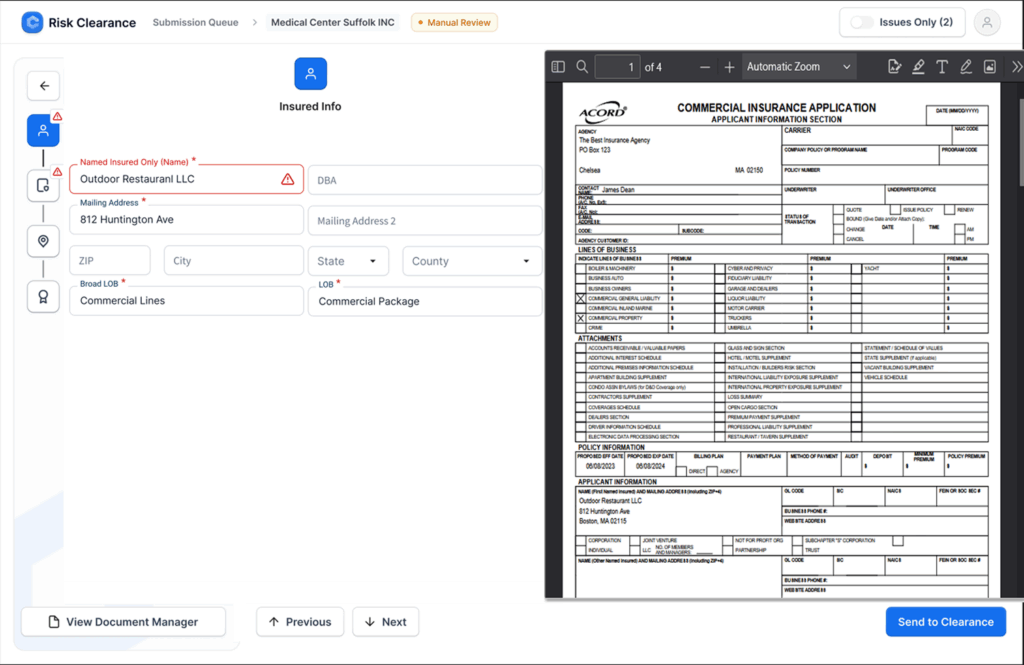
The platform focuses on the workflow stages where automation delivers the most value: intake, document handling, data extraction, validation, and preparation. Bound AI structures messy submissions, extracts data from loss runs, schedules of values, and applications, and flags inconsistencies before files ever reach an underwriter. This creates a clean, consistent starting point without prematurely advancing decisions.
Bound AI also supports governance rather than bypassing it. Every step is visible. Rules are defined by the organization. Exceptions surface clearly, and human review remains embedded at the points where judgment, authority, and accountability matter.
This approach aligns automation with how commercial insurance actually operates. By automating structure and supporting decision-making instead of replacing it, Bound AI helps insurers move faster while maintaining control, auditability, and trust with carrier partners.
The Bottom Line
End-to-end automation is a compelling story, but it isn’t an operating reality in commercial insurance. The complexity, variability, and accountability built into underwriting make full automation fragile and risky at scale.
The insurers that succeed don’t chase total automation. They automate where structure and consistency matter, and they preserve human judgment where context, interpretation, and responsibility can’t be reduced to rules. They design workflows that move faster without losing visibility, control, or auditability.
Automation creates value when it prepares work, enforces discipline, and surfaces exceptions. It creates risk when it bypasses judgment and hides decision-making in the name of speed.
In commercial, specialty, and delegated authority environments, realism beats ambition. The future belongs to automation strategies that respect how insurance actually works and build systems that support people, rather than pretending they can replace them.